What ΔSR means
For a cell i, a simple representation is ΔSRi(t) = Xi(t) − Xi(0), where X is an observable state. The important point is not subtraction. If baseline and endpoint are already known, a single delta does not create new information. The hypothesis concerns the value of additional, correctly linked observations between those states.
What VitraCell's synthetic study was designed to test
The computational study deliberately created two worlds: one in which early response history contains information about a simulated later fate, and a null world in which it does not. It then stress-tested how identity errors, measurement noise, sampling loss and validation strategy affect the apparent value of full history.
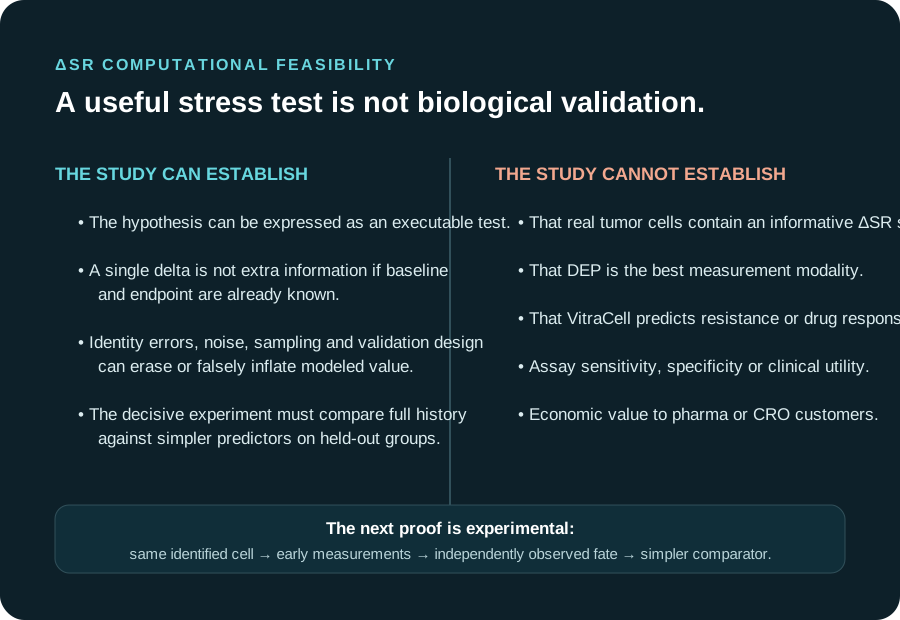
What the simulation can establish
- The proposed comparison is computationally executable.
- History only helps when the generating mechanism actually contains informative temporal structure.
- Identity integrity and measurement precision can constrain the modeled benefit.
- Random cell-level train/test splits can overstate performance when run-specific effects are present.
- A biological study can be designed with explicit nulls and failure criteria.
Questions reserved for sponsor studies
- Which observable carries the most useful early response signal in the selected model.
- Whether dielectric, imaging, biomass or another modality is the best practical measurement.
- How much incremental information full history adds beyond the sponsor's endpoint.
- How identity retention and dropout affect usable low-input records.
- Whether the result changes a downstream development decision.
The discriminating biological experiment
The first experiment should use a controlled model with stable cell identity, a defined treatment and an independently observed fate endpoint. It should compare baseline, endpoint, baseline-plus-endpoint, full longitudinal history, matched-budget repeated measurements and shuffled-identity controls. Entire acquisition runs—not random individual cells from the same run—should be held out for evaluation.
Why VitraCell is keeping the framework measurement-agnostic initially
VitraCell's submitted development program includes dielectric characterization, but the biological question comes first. If no early state trajectory adds meaningful information, optimizing a particular sensor cannot rescue the thesis. If a reproducible trajectory exists, dielectric response can then be tested as one candidate nondestructive measurement rather than assumed to be the answer.
Version 1.0 is a synthetic computational methods study using published aggregate parameter values. The public-review manuscript is being sequenced with publication and intellectual-property review; biological performance is established in model-specific sponsor studies.
Why publish a negative-capable framework?
VitraCell's value should not depend on a simulation that was guaranteed to succeed. The purpose of the framework is to make failure visible early. If full same-cell history does not add decision-relevant information beyond simpler measurements, VitraCell should know that before committing major capital to specialized hardware.